


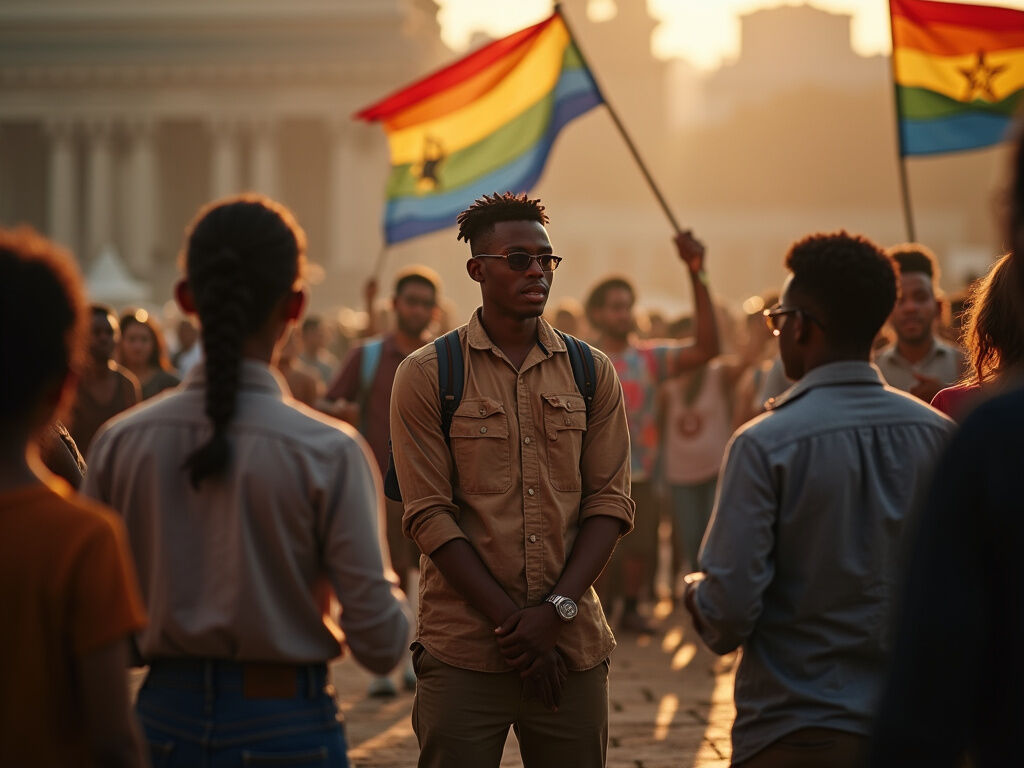
For nearly two decades, Ghana’s political landscape has been deeply divided over the issue of LGBTQ+ rights, with the Human Sexual Rights and Family Values Bill emerging as one of the most polarising legislative proposals in recent history. Initially championed by both ruling and opposition parties, backed by influential religious and conservative groups, and supported by a significant portion of the public, the bill was widely anticipated to become a landmark social law in Ghana’s democratic trajectory. However, as the legislation neared passage in late May 2024, it has instead unleashed a political storm, exposing fractures within the government, opposition factions, and civil society—while raising critical questions about Ghana’s balancing act between domestic moral imperatives and international economic realities.
A Bill That Divided Before It Divided Further
The original version of the Human Sexual Rights and Family Values Bill, first introduced in 2019, was a product of broad consensus. It was co-sponsored by members of the National Democratic Congress (NDC)—then in opposition—and the New Patriotic Party (NPP), Ghana’s two dominant political parties. Religious leaders, including prominent figures from the Ghana Assemblies of God and the Muslim Council of Ghana, lent their moral weight to the cause, framing the bill as essential for protecting “traditional family values” against what they described as a growing threat from LGBTQ+ advocacy.
Public opinion polls at the time reflected this alignment, with majority support among Ghanaians for stricter laws against same-sex relations. The bill’s provisions included heavy penalties—up to three years in prison—for promoting or engaging in LGBTQ+ activities, as well as restrictions on foreign funding for organisations perceived to support LGBTQ+ rights.
Yet, despite this initial unity, the bill’s journey through parliament has been contentious from the start. Critics, including human rights organisations and international donors, warned that the legislation risked alienating Ghana from global financial institutions, jeopardising aid flows, and deterring foreign investment—a concern that has now become a central point of contention.
The Government’s Dilemma: Softening the Bill or Losing Support
On 29 May 2024, after months of deliberation, parliament passed a revised version of the bill. However, the amendments introduced by the government—particularly in Clause 9—have sparked outrage among its original supporters, who argue that the changes gut the bill’s intended deterrent effect.
Opposition MP John Ntim Fordjour, a key architect of the original legislation, told The Africa Report that the revised version introduces “dangerous loopholes” that could undermine its purpose. The most controversial changes include exemptions for legal practitioners, academics, journalists, public health institutions, and courtroom participants from penalties under the bill.
Fordjour and other critics argue that these exemptions effectively neutralise the law’s teeth, allowing advocacy groups to operate under legal protections while still promoting LGBTQ+ causes. “The old bill was what had the deterrence,” Fordjour stated. “The version that had the bite. What parliament has passed now creates pathways for advocacy and promotion under different guises. The original bill was carefully crafted to close those gaps. Now, years of consensus-building could be wasted.”
The criticism is particularly painful for the NDC, as many of its lawmakers had previously voted in favour of the original bill while in opposition. Now, as the ruling party, the government faces internal pressure from its own supporters who feel betrayed by what they perceive as a watered-down compromise.
Economic Realities vs. Moral Imperatives: The IMF and World Bank Factor
The government’s decision to amend the bill is not merely a political maneuver—it is also a strategic response to Ghana’s economic vulnerabilities. The country remains heavily dependent on international financial support, with ongoing negotiations with the International Monetary Fund (IMF) and World Bank for bailout packages to stabilise its economy. Additionally, Ghana is seeking foreign direct investment (FDI) and donor funding to revive growth, which has been hampered by inflation, debt distress, and currency devaluation.
The original version of the bill sparked warnings from Western governments, human rights groups, and development partners. The U.S. State Department, the European Union, and organisations like Amnesty International and Human Rights Watch had expressed concerns that the legislation could trigger sanctions, aid restrictions, or investor pullouts. Some donors had already frozen funding to NGOs perceived as LGBTQ+-supportive, and the risk of further economic isolation was real.
Economist Daniel Amateye Anim-Prempeh, a senior fellow at Policy Initiatives for Economic Development (PIED Africa), explained that the Mahama administration is now operating from a different political calculus. “The Mahama government is approaching this from a position of governing responsibility, not opposition politics,” he said. “Government officials understand that Ghana operates within a global financial ecosystem. They are acutely aware of the potential consequences—sanctions, aid restrictions, investor uncertainty, and reputational damage. That’s why there appears to be an effort to soften provisions that are internationally seen as overly punitive.”
This shift has not gone unnoticed. President John Mahama, in a recent address at Chatham House in London, hinted at the legal and procedural hurdles the bill may face before becoming law. “Once the president receives it, you go through it because you’re not part of the discussion in parliament,” Mahama said. “The legal representative, the legal counsel in the presidency, and the Attorney General would review it… and ensure everything is in order before the president is advised to assent.”
Mahama also suggested that substantial issues raised during the parliamentary process could lead to the bill being returned for further revisions. “If there are issues—substantial issues—that are raised, the president would return the bill to parliament, indicating exactly what the issues are,” he stated.
Parliament’s Surprise Passage and the Road Ahead
The speed and secrecy with which the revised bill was passed in parliament have further undermined trust among its supporters. Speaker of Parliament Alban Bagbin admitted that the passage came as a surprise, stating: “When it was passed on Friday, it was even a surprise to me, because I knew they were going to start the consideration of the bill, and that was the instruction I left before I went to attend to other meetings.”
Civil society groups that had long advocated for the bill are now calling for caution and further deliberation. Edem Senanu, leader of Advocates for Christ Ghana, a prominent Christian advocacy group, urged a pause in the legislative process. “There is no need to rush this bill,” Senanu said. “It’s a good thing that they are taking a second look at it. I also think the president might have to send it back to parliament to take another look. We need to achieve a consensus.”
Senanu acknowledged that while the bill’s intent remains valid, the exemptions in the revised version raise legitimate concerns. “Looking at the bill, if the version I have and the exemptions are correct, I do have some concerns,” he admitted. “We need to ensure that the bill remains strong enough to protect our values without creating unintended consequences.”
A Nation at a Crossroads
The controversy over the Human Sexual Rights and Family Values Bill is more than just a legislative dispute—it is a microcosm of Ghana’s broader challenges. The country is caught between:
– Domestic moral and cultural expectations, where traditional values hold significant sway.
– Economic realities, where international financial support is non-negotiable.
– Political pragmatism, where governing requires navigating both domestic and global pressures.
For the NDC, the situation is particularly delicate. The party’s base of support includes many who see LGBTQ+ rights as a moral threat, yet the government must also appease international donors to secure much-needed economic relief. The risk of alienating either constituency is high, and the public perception of a “sellout” could have severe political repercussions.
Meanwhile, opposition parties—particularly the NPP, which has historically been more pro-business and internationally aligned—may see an opportunity to exploit the government’s perceived weakness on the issue. If the bill is sent back to parliament for further revisions, it could become a political football, with each side accusing the other of caving to foreign pressure or betraying national values.
Conclusion: A Bill That Could Define Ghana’s Future
As Ghana navigates this high-stakes legislative battle, the outcome of the Human Sexual Rights and Family Values Bill could have lasting consequences. If the government pushes through the revised version, it may satisfy some domestic critics but risk further isolating Ghana from global financial institutions. If, however, the bill is returned for further amendments—or even shelved entirely—it could undermine the credibility of both the government and its opponents, leaving the LGBTQ+ issue unresolved and the political divide even more entrenched.
One thing is certain: Ghana’s political class can no longer afford to ignore the economic implications of its moral stance. The bill’s fate will not only test the government’s ability to govern but also Ghana’s capacity to reconcile its national identity with the demands of the global economy. In a country where economic survival and cultural preservation are often pitted against each other, the choices ahead are fraught with consequences—for the nation’s social fabric, its political stability, and its economic future.