


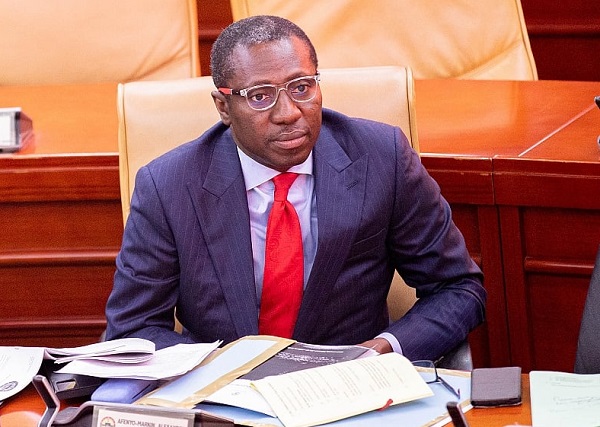
In a scathing critique delivered during the recent debate on the Mid-Year Budget Review (MYBR), Mr. Alexander Afenyo-Markin, the Minority Leader in Parliament, has accused the government of presenting a document laden with political posturing rather than substantive economic solutions. His remarks, delivered on the floor of Parliament, underscored a growing disillusionment among opposition lawmakers over what they perceive as a failure to address the pressing economic challenges facing ordinary Ghanaians.
“Books of Empty Promises, Not Economic Solutions”
Afenyo-Markin’s critique was direct and unfiltered. He dismissed the MYBR as “full of English and empty payments”, a phrase that encapsulates his belief that the government’s financial projections and policy announcements lack tangible impact on the lives of citizens. His stance was reinforced when he declared:
“We’re not interested in your books; we’re interested in the economy of our pocket.”
This statement reflects a broader sentiment among opposition members that budgetary presentations are often detached from the real-world struggles of Ghanaians, particularly in areas such as rising cost of living, unemployment, and inadequate social services.
Political Persecution and the Case of Bernard Antwi-Boasiako
Afenyo-Markin’s address also touched on allegations of political persecution, a recurring theme in Ghana’s political discourse. He specifically highlighted the case of Mr. Bernard Antwi-Boasiako, the Ashanti Regional Chairman of the New Patriotic Party (NPP), popularly known as “Chairman Wontumi”. Afenyo-Markin described Antwi-Boasiako as a “political prisoner”, suggesting that his detention or legal troubles are motivated by political motives rather than legal merit.
The Minority Leader’s remarks come amid ongoing tensions between the ruling National Democratic Congress (NDC) and opposition parties, with accusations of targeted harassment, arbitrary arrests, and suppression of dissent gaining traction in recent months.
Broken Campaign Promises and Abandoned Initiatives
Beyond the MYBR, Afenyo-Markin criticised the NDC government’s track record, arguing that it has failed to deliver on key campaign promises while discontinuing successful programmes introduced by the previous NPP administration.
One such initiative he mentioned was the One District, One Factory (1D1F) programme, which was launched under the NPP government to promote industrialisation and job creation at the local level. Afenyo-Markin argued that the abandonment of such programmes signals a lack of long-term economic planning and a failure to build sustainable development strategies.
He further alleged that the NDC’s economic policies have not translated into meaningful improvements for citizens, leaving many to question the government’s commitment to addressing structural economic challenges.
A Call for Accountability and Scrutiny
Despite the political climate, Afenyo-Markin reaffirmed the Minority Caucus’s commitment to holding the government accountable. He emphasised that parliamentary oversight remains crucial in ensuring that public resources are used efficiently and that policies reflect the needs of the people.
“The Minority would continue to scrutinise the Government’s policies and programmes to ensure accountability and safeguard the interests of the Ghanaian people.”
His remarks underscore the opposition’s determination to challenge the government’s economic narrative, particularly as inflation, debt concerns, and unemployment continue to weigh heavily on Ghana’s economic outlook.
The Broader Implications for Ghana’s Economic Future
Afenyo-Markin’s critique is not isolated but part of a broader debate over Ghana’s economic direction. With the Mid-Year Budget Review serving as a midpoint assessment of the government’s fiscal performance, critics argue that transparency, accountability, and citizen-centric policies must take precedence over political rhetoric.
As Ghana navigates rising debt levels, currency depreciation, and fiscal constraints, the effectiveness of economic policies will be judged not just by budgetary figures but by their real-world impact on the lives of ordinary citizens. The Minority Leader’s stance reflects a growing demand for tangible results, suggesting that political divisions may deepen unless substantive progress is made.
For now, the Mid-Year Budget Review stands as a document of debate, with opposition lawmakers demanding more than words—they are calling for actionable solutions that can improve livelihoods and restore economic confidence.