


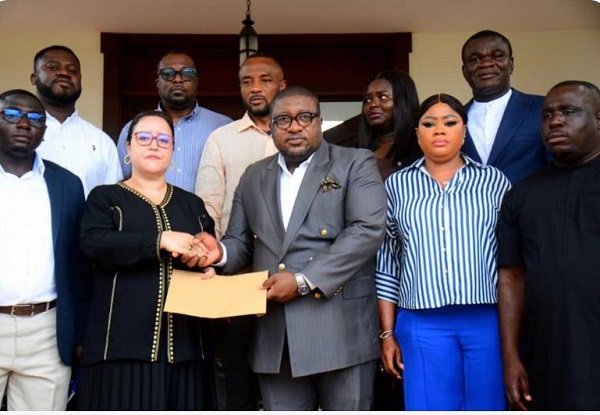
The New Patriotic Party (NPP) has formally escalated its concerns to Ghana’s diplomatic community, accusing the government of systematic political persecution, suppression of dissent, and a dangerous erosion of democratic norms under President John Dramani Mahama’s administration. In a comprehensive petition delivered to members of the diplomatic corps in Accra, the party has detailed allegations of unconstitutional arrests, judicial bias, and the weaponisation of state institutions against opposition figures, journalists, and critics.
A Culture of Intimidation and the Criminalisation of Free Speech
The NPP’s statement, issued on Wednesday, paints a disturbing picture of Ghana’s democratic landscape, warning that the country’s long-standing reputation as a stable and democratic nation is under serious threat. The party claims that political opponents, activists, and independent voices are increasingly subjected to arbitrary arrests, baseless prosecutions, and intimidation tactics, creating an environment where free expression is under siege.
“This is not just about individual cases—it is a deliberate strategy to silence dissent and enforce a culture of silence,” the NPP stated. “Ghana’s democratic gains are being systematically undermined by a government that appears willing to use any means—legal or otherwise—to suppress opposition.”
The party explicitly accused the government of weaponising state institutions, including the judiciary, police, and intelligence agencies, to target political adversaries. It argued that such actions violate Ghana’s constitutional protections and undermine the rule of law, which has been a cornerstone of the nation’s post-colonial governance.
High-Profile Cases of Political Persecution
The NPP highlighted several recent incidents to substantiate its claims, including the high-profile arrest and detention of Kwame Baffoe, popularly known as Abronye DC, the Western Region Chairman of the NPP.
Baffoe was detained and charged after making public remarks critical of a judge, a case the party described as “a blatant attempt to criminalise free speech.” Despite no credible evidence linking his statements to any criminal offence, he was denied bail, raising concerns about judicial bias and selective enforcement of the law.
The NPP further cited multiple other cases where opposition members, journalists, and civil society activists have been arrested under suspicious circumstances, often during dramatic police raids conducted in the early hours of the morning. Many of these individuals have been held in prolonged detention without charge, a practice the party condemned as “a deliberate tactic to intimidate and weaken opposition movements.”
The Repeal of Criminal Libel and Its Undermining
Ghana’s 2001 repeal of criminal libel laws under former President John Agyekum Kufuor was hailed as a landmark reform that strengthened press freedom and democratic expression. However, the NPP argued that the current administration has found alternative ways to stifle criticism, including through strategic use of defamation, sedition, and cybercrime laws to penalise dissenting voices.
“While the government claims to uphold press freedom, the reality is that journalists and critics are increasingly being targeted through legal technicalities,” the party stated. “This is not about justice—it is about silencing those who dare to challenge the status quo.”
Judicial Independence Under Scrutiny
One of the most alarming developments, according to the NPP, has been the removal of Chief Justice Gertrude Araba Esaaba Sackey Torkornoo—a move the party linked to growing concerns over judicial independence.
The NPP warned that the removal has fuelled suspicions that judges may face pressure when handling politically sensitive cases, particularly those involving opposition figures or government critics. “This is not just about one judge—it is about a broader pattern of interference in the judiciary,” the party stated. “If the rule of law is to mean anything, Ghana’s courts must be seen as impartial and free from political influence.”
Selective Justice and the Misuse of State Agencies
The petition also accused the government of applying the law selectively, with NPP members facing swift investigations and prosecutions while alleged allies of the ruling party often evade accountability for similar offences.
“This is not justice—it is double standards,” the NPP argued. “When the police and intelligence services are used to target opposition leaders while their counterparts in government face no consequences, it sends a clear message: the law is not for everyone.”
The party further criticised the government’s handling of protests, claiming that peaceful demonstrations by opposition supporters are met with excessive force, while pro-government rallies are allowed to proceed without interference.
A Call for International Intervention
In light of these deepening concerns, the NPP has urged the diplomatic community, development partners, and human rights organisations to actively monitor developments in Ghana and hold the government accountable.
“Ghana’s democratic future is at a crossroads,” the party stated. “We cannot allow our nation to slide into authoritarianism under the guise of stability. The international community must speak out, engage with the government, and ensure that free speech and the rule of law are protected.”
The NPP’s petition marks a significant escalation in its public campaign against perceived government overreach, signalling that the party intends to leverage international pressure to halt what it describes as a dangerous drift away from democracy.
As the situation unfolds, observers both locally and internationally will be watching closely to see whether Ghana’s democratic institutions can withstand the current challenges or if the trend toward political repression continues unchecked.