


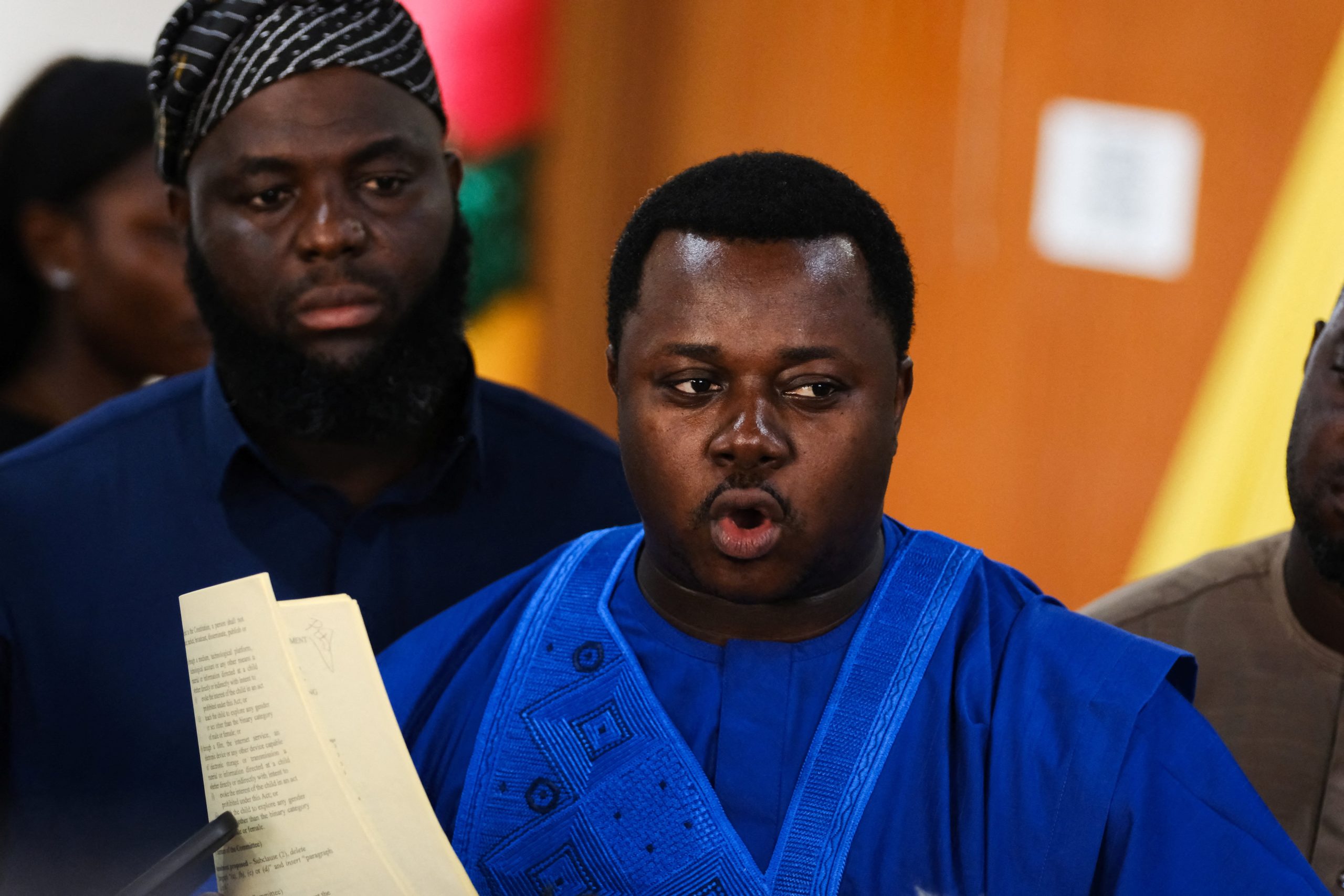
For nearly two decades, Ghana’s political landscape has been shaped by intense debates over social values, with few issues sparking as much fervour—and division—as the proposed Human Sexual Rights and Family Values Bill. Initially presented as a unifying force, the legislation—backed by major political parties, religious institutions, and significant segments of the public—was widely anticipated to become one of Ghana’s most consequential social laws. However, just two years after its introduction, the bill has instead emerged as a deeply divisive force, exposing fractures within the ruling National Democratic Congress (NDC), straining government alliances, and forcing a reckoning between domestic political priorities and Ghana’s reliance on international financial support.
A Bill That Once United Now Splits the Nation
The original bill, championed by both the NDC and the opposition New Patriotic Party (NPP), was framed as a moral and cultural safeguard, reflecting Ghana’s deeply conservative social fabric. Influential Christian denominations, Muslim organizations, and traditional leaders rallied behind it, portraying LGBTQ+ rights as a Western imposition threatening Ghana’s cultural identity. Public opinion polls at the time consistently showed strong majority support, with many Ghanaians viewing the legislation as a necessary defence against perceived “degeneracy.”
Yet, the bill’s passage in its revised form on May 29, 2024, has instead unleashed a political storm. Opposition Members of Parliament (MPs) who had previously co-sponsored and lobbied for the original draft now accuse the government of watering down its effectiveness through amendments that critics argue create loopholes and undermine its deterrent power.
“The old bill was the one with teeth,” declared John Ntim Fordjour, a prominent opposition MP and co-sponsor of the legislation. “The version passed by parliament introduces dangerous exemptions that could be exploited to circumvent its intent.” Fordjour and other supporters argue that the revised bill, particularly Clause 9, now includes critical exemptions for legal professionals, academics, journalists, public health institutions, and courtroom participants—provisions they claim were deliberately omitted in the original draft to prevent any form of advocacy or promotion of LGBTQ+ rights under any guise.
“These exemptions may seem technical, but they are legally and socially significant,” Fordjour stated. “They open doors for advocacy groups to operate within legal grey areas. The original bill was designed to close those gaps. Now, years of consensus-building have been undermined by a weakened version that could be easily challenged in court.”
Government Under Fire: Balancing Domestic Pressure and Global Realities
The NDC’s predicament is acute. Many of its lawmakers had previously publicly endorsed the bill while in opposition, only to now find themselves defending amendments they did not support. The party now faces internal backlash from its own MPs, some of whom have accused the government of caving to international pressure rather than upholding Ghanaian values.
Economist Daniel Amateye Anim-Prempeh, a senior researcher at Policy Initiatives for Economic Development (PIED Africa), suggests that the government’s hesitation stems from realistic economic concerns. Ghana remains highly dependent on foreign aid, IMF/World Bank loans, and foreign direct investment (FDI)—all of which could be threatened by punitive anti-LGBTQ+ legislation.
“The Mahama administration is no longer operating in opposition mode,” Anim-Prempeh told sources. “They are now governing a country that is economically fragile. The government understands that Ghana’s global financial ecosystem is sensitive to such legislation. The risk of sanctions, aid cuts, investor withdrawal, and reputational damage is too high to ignore.”
This tension was exposed in public remarks by President John Mahama during a speech at Chatham House in London. When asked about the bill’s future, Mahama hinted at significant hurdles, suggesting that the legislation would undergo further legal scrutiny before his assent.
“Once the president receives the bill, it goes through a rigorous review process,” Mahama explained. “The legal team, the Attorney General’s office, and the presidency’s counsel will examine it meticulously before advising on assent. If there are substantial legal or procedural concerns, the president may return it to parliament for further debate.”
His comments were interpreted by supporters of the original bill as a green light for a potential return to parliament, where they hope to restore the stricter provisions. Even Speaker of Parliament Alban Bagbin admitted surprise at the bill’s swift passage, stating that he had expected a more deliberative process.
Civil Society Divided: Between Urgency and Caution
The controversy has also polarized civil society groups. Some, like Advocates for Christ Ghana, led by Edem Senanu, argue that rushing the bill through its current form could backfire.
“There is no need to rush this bill,” Senanu stated. “The fact that the president is taking a second look is a positive development. It suggests that stakeholders are finally engaging in meaningful dialogue. If the president returns it to parliament, we should use this opportunity to refine it further and ensure broad consensus.”
Senanu acknowledged some concerns with the revised exemptions, particularly regarding academic and journalistic freedoms, but urged patience. “If the bill is to be effective, it must be both legally robust and socially acceptable. A rushed process could lead to legal challenges and weaken its impact.”
Others, however, remain uncompromising. Religious leaders and conservative activists argue that any dilution of the bill’s original intent is a betrayal of Ghana’s moral values. “We cannot afford to water down our laws just to please foreign donors,” one prominent pastor told sources. “Ghana’s identity is at stake, and we will not back down.”
The Broader Implications: A Test of Ghana’s Political Maturity
The Human Sexual Rights and Family Values Bill is now more than just a legislative proposal—it is a barometer of Ghana’s ability to navigate complex domestic and international pressures. The debate reveals deepening divisions between:
– Conservative factions who prioritize cultural and religious values over economic stability.
– Pragmatic policymakers who recognize the real-world consequences of alienating global investors and donors.
– Legal and academic voices who warn that overly broad legislation could lead to unintended legal battles.
For President Mahama, the decision ahead is highly consequential. If he signs the revised bill, he risks alienating his conservative base while potentially triggering economic fallout. If he returns it to parliament, he may further delay a law that has been debated for years, risking accusations of weakness or indecision.
One thing is clear: Ghana’s political class is no longer united on this issue. What was once a unifying moral cause has instead become a fracturing force, forcing the country to confront whether its values can coexist with its economic survival—or if one must ultimately prevail over the other.
As the debate intensifies, the Human Sexual Rights and Family Values Bill may yet become Ghana’s most contentious legislative battle in years, with outcomes that could reshape the nation’s social and economic trajectory for decades to come.