


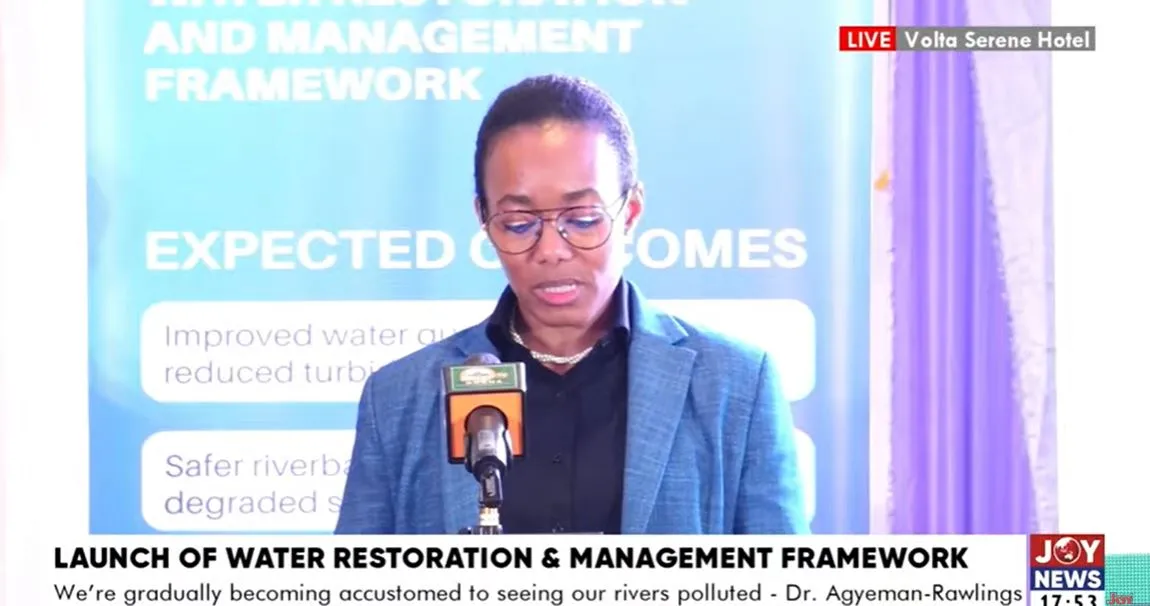
Zanetor directs EPA to map and protect water bodies, buffer zones – Minister for Environment, Science and Technology, Dr Zanetor Agyeman-Rawlings, has directed the Environmental Protection Authority (EPA) to work with relevant state institutions and traditional authorities to map and protect Ghana’s water bodies and their designated riparian buffer zones.
She said the move forms part of efforts to prevent further degradation of rivers and strengthen the protection of the country’s water resources.
Speaking at the launch of the National Water Restoration and Rehabilitation Framework in Ho on Thursday, Dr Agyeman-Rawlings said:
“I am directing the Environmental Protection Authority to work with the Water Resources Commission, relevant ministries, security agencies, MMDAs, and traditional authorities to map these areas, delineate appropriate buffer zones, and take the necessary lawful measures to protect them.”
The Minister described the protection of water bodies and their buffer zones as a “national environmental security policy”, warning that access to clean water was fundamental to human security.
She said the destruction of water resources threatened food security, public health, economic stability and national security.
Dr Agyeman-Rawlings also cautioned against allowing activities undertaken under the guise of dredging, reclamation or restoration to become avenues for unauthorised mining and further pollution.
“Changing the terminology does not change the environmental impact of an activity. All such interventions must comply with the relevant environmental regulations and must not become further avenues for unauthorised mining or further pollution,” she said.
She stressed that the first principle of any restoration programme must be to prevent further destruction, arguing that resources should not be spent restoring rivers downstream while pollution and degradation continue upstream.
The Minister further directed the EPA to identify priority water bodies, establish reliable baseline water quality data, assess sources of pollution and set measurable restoration targets.
She said the EPA must work with scientific institutions, including the Council for Scientific and Industrial Research (CSIR), the Ghana Atomic Energy Commission and universities, to ensure restoration interventions are guided by scientific evidence.
Diaspora Perspectives & UK-Ghana Linkages: The developments concerning ‘Zanetor directs EPA to map and protect water bodies, buffer zones’ have sparked significant dialogue among Ghanaian communities in the United Kingdom and across Europe. Diaspora stakeholders and business associations continue to examine the economic and social ramifications, highlighting the enduring bridge between home institutions and global Ghanaian interests.