


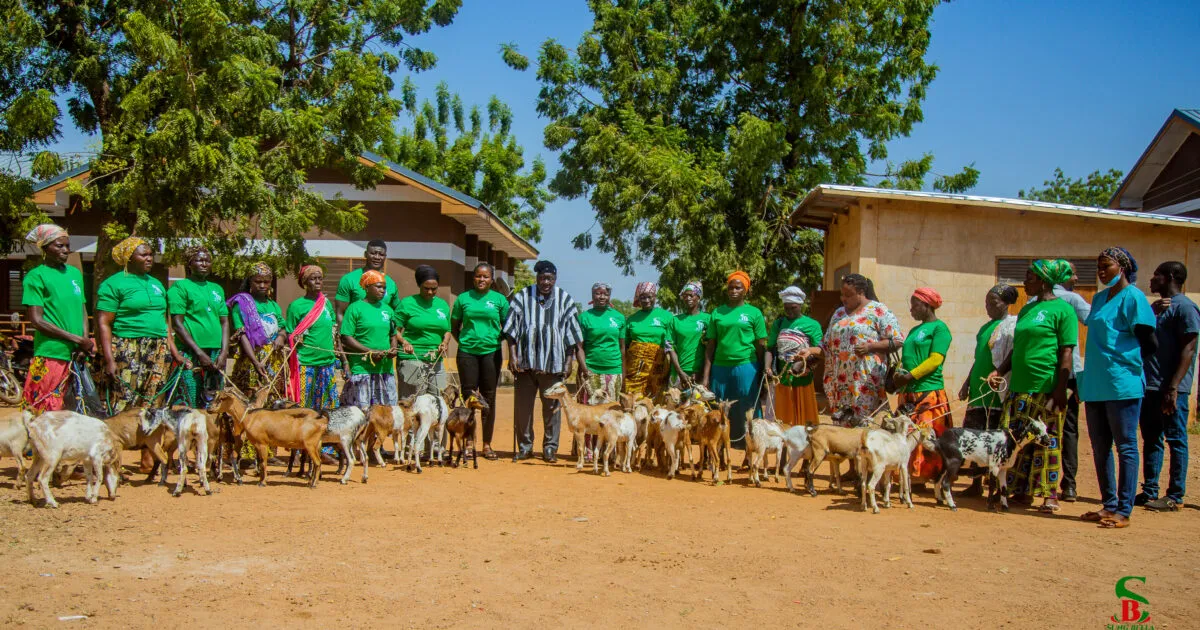
Two nanny goats, a new hope: Kusaug women seek a path to economic independence – Ndeego Rita from Bazua in the Bawku area has six children and no husband. Providing for them is a responsibility she carries largely on her own. Now, with two goats to take home, she is hoping to build something that will support the family in the years ahead.
“I have six children but no husband, so as I have gotten this, I thank God so much. I pray that God will place His blessed hands on it and make it grow to be of help to my children and me,” she said.
For Rita and the other women selected, the goats represent an opportunity to own something that can grow in value rather than a form of assistance that is exhausted after a few days.
Abugri Monica, from Zawse, is already thinking about what the animals could mean for her household. She says she is determined to care for them as carefully as she would if she had bought them with her own money.
“Maybe I didn’t have any animal at home. Even if I get one and send it home, there will now be three, and it will be of help to me,” she said.
Monica said receiving the animals had made her happy, but she also understood that keeping them healthy would be her responsibility.
“I will not be like, ‘After all, it is a gift,’ and be careless with it to get lost,” she said.
Her determination reflects an important part of the initiative: the women are expected to manage the animals, allow them to reproduce and gradually build their own livestock holdings.
Asaana Theresah, from Goore, sees the intervention as an investment that could benefit not only the women receiving the animals but also their children.
“I see this as a great gift because anything that is given to you which is not to be consumed just today is something that grows. If you are able to take care of it well, it will help you and your children tomorrow,” she said.
She hopes the initiative will eventually reach other women who were unable to benefit from the first round.
“If we are able to take care of the animals very well for them to give birth and grow, it will bring growth to us and the entire Kusaug,” she said.
The 15 women are the first beneficiaries of a five-year project by the Sung Biela Foundation, a G non-governmental organisation working in the Upper East Region particularly Bawku area of the Kusaug Traditional Area.
The foundation’s founder, Hajia Zeinab Awinbe Salifu, said the project aims to empower approximately 150 women over five years.
The first group of 15 women has received two female goats each, alongside financial assistance to support the feeding of the animals.
The idea is to help the women build productive assets that can multiply and eventually provide income for their households.
Hajia Salifu said the foundation hoped that within two or three years, the beneficiaries would have increased their livestock holdings sufficiently to sell some animals and use the proceeds to support their children’s education.
Many of the women selected are widows, some with between four and six dependants. Their economic difficulties have also been compounded by the conflict situation in the area, she said.
For women without a reliable source of income, meeting household needs and keeping children in school can be particularly difficult.
“When women are not empowered, they can lose their confidence and economic independence, and this can affect the entire household,” Hajia Salifu said.
“However, when women are empowered, their households benefit. They have an opportunity to earn an income, support their families and improve the welfare of their children.”
The foundation, established in 2013, has previously supported visually impaired students through their education, provided textbooks and other teaching materials to schools, and assisted people with livelihood development.
One of its beneficiaries was a young man who lost both legs following an accident while working in Kumasi. Hajia Salifu said the foundation helped him establish a business in Garu, where he has since been doing well.
Some visually impaired students supported by the organisation from junior high school through university have also progressed to national service.
However, the livestock project marks a new area of intervention for the foundation, with the intention of helping women develop an asset they can manage and expand over time.
Haji Salifu said the organisation was seeking partnerships with NGOs and other institutions to extend its work to more vulnerable women and children.
“To me, touching another person’s life is the true meaning of living. That is what the foundation exists to do,” she said.
Protecting the animals and the investment
The success of the project will depend partly on whether the beneficiaries can keep the goats healthy and ensure they reproduce.
To support this, the foundation engaged the Veterinary Services Department to help select suitable animals and train the women in livestock management.
Adongo Issifu Rahman, the Project Veterinary Officer with the Veterinary Services Department in Binduri, said veterinary officers helped select healthy goats with good reproductive potential before the distribution.
The animals were also given preventive treatment and vaccinated against Peste des petits ruminants (PPR), a major disease affecting goats and sheep.
During the training, the beneficiaries were introduced to appropriate housing, feeding and watering practices, as well as internal and external parasite control and biosecurity measures.
Mr Rahman said proper animal selection and management were important to improving livestock productivity.
He urged the women to take the responsibility seriously, describing the goats as assets that could grow if properly managed.
“Do not regard the goats you have received today simply as gifts, but as seeds you must plant and nurture,” he advised.
He said the women’s responses during the training suggested they were enthusiastic about raising the animals and understood the responsibility involved.
He expressed hope that additional funding would enable the foundation to extend the intervention to more women.
The Department of Social Welfare and Community Development at the Bawku Municipal Assembly has also welcomed the intervention.
Theresah Akugri, representing the department, said the initiative aligned with efforts to support poor and vulnerable people through livelihood development.
She said providing small ruminants could help women build livestock holdings and eventually generate additional economic benefits for their households.
“When women are deliberately empowered, the benefits extend beyond the individual beneficiaries to their households. It can improve household consumption and provide women with an additional source of livelihood,” she said.
Mrs Akugri urged the beneficiaries to take proper care of the animals to ensure they achieved the intended benefits.
For the women, however, the immediate task is to turn the two goats into a growing livestock holding. That will require regular feeding, proper housing, disease prevention and continued care.
Monica hopes that if the animals multiply, she will be able to encourage other women in her community who were not selected to remain hopeful.
Her expectation reflects the wider ambition of the project: that an opportunity given to a small group of women could eventually extend to others and help families build more secure livelihoods.
For Rita, the hope is more personal. She wants the animals to grow and become a source of support for her six children.
Whether the project achieves its five-year target will depend on sustained care, veterinary support and the foundation’s ability to secure resources for expansion. But for the first 15 women, the journey towards building those assets has begun.