


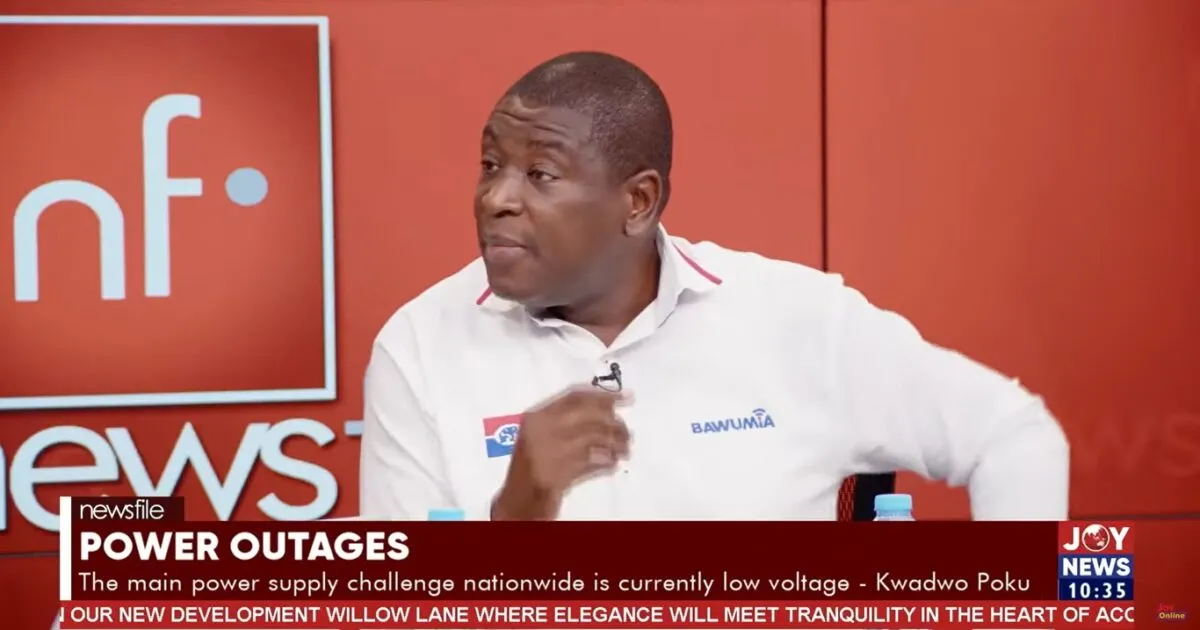
Transmission gaps driving power outages despite improved generation – Energy analyst – The Executive Director of the Institute of Energy Policies and Research, Kwadwo Poku, has blamed persistent power outages in parts of the country on inadequate investment in electricity transmission infrastructure.
He argues that Ghana’s electricity challenges cannot be addressed by focusing solely on increasing generation capacity, insisting that the country’s transmission network has become a major source of instability in the power sector.
Speaking on JoyNews’ Newsfile on Saturday, November 28, 2026, he said he had predicted six years ago that Ghana’s next major electricity disruption would stem from transmission rather than generation.
“In 2020, I made a statement that the next erratic power disruption in this country will be transmission, not generation,” he said.
According to him, although there have been improvements in electricity generation and gas supply, consumers continue to experience power outages because the transmission challenges remain unresolved.
“So my brother is talking about this enough generation, we agree with him. The gas issue, we’ve agreed with him. Or there’s been improvement in all the things he talks about. But some say, everybody watching us today know that the lights are still going off,” he stated.
Mr Poku said the country’s electricity sector required a comprehensive approach that addressed generation, transmission and distribution rather than concentrating resources on one component.
He maintained that the current situation reflected years of inadequate attention to the transmission network, which he said was struggling to move electricity from generating stations to areas with growing demand.
He cited the increasing demand for electricity in the northern and middle belt regions, arguing that the concentration of generation facilities in the south had created additional pressure on the transmission network.
“There is no way to transmit that power to where the demand points are,” he said.
Mr Poku also attributed some of the recent electricity challenges to the impact of weather conditions on the power system.
He explained that electricity demand generally declines during the cooler months, particularly between June and September, when households and businesses use air conditioners less frequently.
“When it’s cold, we have winter in Ghana and nobody seems to acknowledge that,” he said.
He added that electricity demand could drop by approximately 300 megawatts across the national grid during the cooler period, easing pressure on transmission infrastructure.
He said the return of hotter weather subsequently increases demand and exposes weaknesses in the electricity system.
Mr Poku further argued that the government must prioritise investments in transmission infrastructure alongside plans to expand generation capacity.
“The bottom line is what? And the problem is the lack of investment in the last two years in the transmission,” he said.
He warned that without urgent interventions, consumers could continue to experience electricity supply challenges despite improvements in generation capacity.
He also suggested that the challenges would persist for some time, arguing that the transmission investments required to address them could not be completed immediately.