


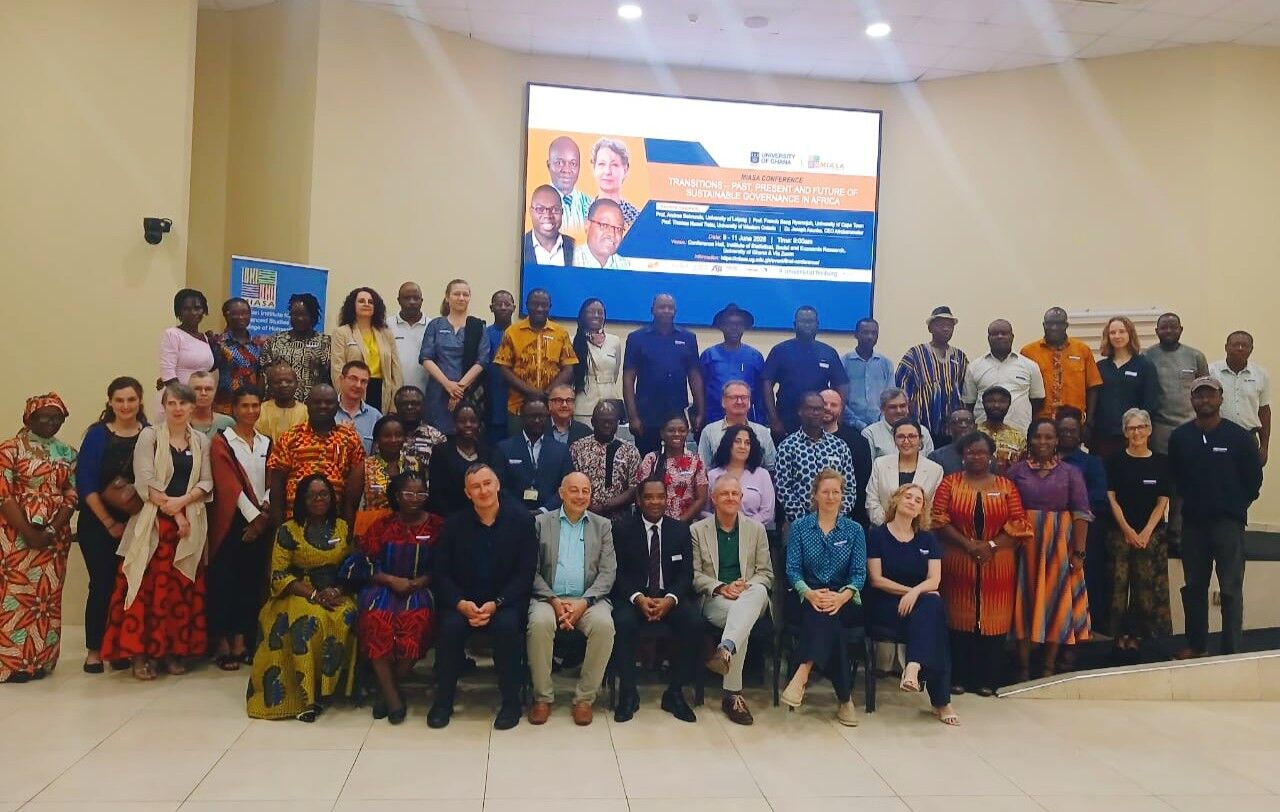
Africa’s path to sustainable development and lasting peace hinges on a fundamental shift in governance—one that prioritizes interdependence, systemic collaboration, and structural reform at every level, from local communities to continental institutions. This was the central argument presented by leading African scholars, policymakers, and international diplomats at the Merian Institute for Advanced Studies in Africa (MIASA) Conference in Accra, themed “Transitions – Past, Present, and Future of Sustainable Governance in Africa.”
For decades, African nations have invested heavily in security, conflict resolution, and peacekeeping, yet persistent challenges—such as structural violence, systemic inequality, and marginalization—continue to stifle progress. Experts at the conference warned that while armed conflict remains a visible threat, the invisible yet devastating effects of structural violence—including extreme poverty, discrimination, and unequal access to resources—remain the most formidable obstacles to sustainable development.
The Scourge of Structural Violence: A Silent Crisis
Prof. Thomas Kwesi Tieku, a distinguished scholar in Politics and International Relations, delivered a keynote address titled “Beyond Firefighting: Towards a Sustainable Peace Framework for Africa.” He argued that Africa’s “peace deficit” is not merely a security issue but a sustainable governance crisis, deeply rooted in decades of systemic neglect.
“Structural violence—manifested through extreme poverty, hardship, inequality, and marginalization—is a daily reality for millions across Africa,” Prof. Tieku stated. “Symbolic violence, where domination, discrimination, and unequal social relations are normalized, has become an accepted way of life in too many societies.” He emphasized that while armed conflicts receive immediate attention, the long-term damage of structural violence—such as food insecurity, lack of education, and economic exclusion—undermines stability far more profoundly.
A Multi-Level Approach to Sustainable Governance
To address these challenges, Prof. Tieku proposed a three-tiered governance framework, requiring coordinated action at local, national, regional, and continental levels:
- Local Level: Legitimacy and Community Ownership
- Sustainable governance must begin with grassroots legitimacy, ensuring that local communities have a meaningful role in decision-making.
-
Policies must be community-driven, addressing immediate needs while fostering long-term resilience.
-
National Level: Public Goods and State Capacity
- Governments must strengthen state institutions to deliver essential services—such as healthcare, education, and infrastructure—equitably.
-
Effective public goods provision is critical to reducing inequality and preventing social unrest.
-
Regional Level: Collective Action and Shared Solutions
- Regional bodies (e.g., ECOWAS, AU, and SADC) must adopt coordinated approaches to manage collective action problems, such as cross-border conflicts, migration crises, and economic disparities.
-
Regional integration should extend beyond trade to include security, climate resilience, and social welfare.
-
Continental Level: Shared Ambitions and Global Engagement
- Africa must unify its voice on the global stage, advocating for fair trade, debt relief, and technology transfer to accelerate development.
- Norms and shared goals—such as African-led solutions to climate change and pandemics—should define Africa’s position in international diplomacy.
Ghana’s Role as a Model of Governance and Academic Leadership
The conference also highlighted Ghana’s transformative journey over the past three decades, marked by political stability, economic growth, and intellectual leadership. Mr. Sivine Jansen, Deputy German Ambassador to Ghana, commended the country’s democratic resilience and economic excellence, noting that Ghana’s institutions—particularly the University of Ghana—have played a pivotal role in shaping public discourse and governance reforms.
“Ghana has demonstrated that critical debate, institutional strength, and economic pragmatism can drive sustainable development,” Jansen stated. He praised the MIASA-University of Ghana collaboration as a beacon for African scholarship, fostering interdisciplinary dialogue among scholars, policymakers, and young researchers across the continent.
MIASA’s Mission: African-Centric Solutions for Global Challenges
Since its establishment in 2018, the Merian Institute for Advanced Studies in Africa (MIASA)—a partnership between the University of Ghana and four German institutions (University of Freiburg, Goethe University Frankfurt, German Institute for Global and Area Studies, and German Historical Institute Paris)—has been at the forefront of African-led research on sustainable governance.
Madam Grace Diabah, Director of MIASA-Ghana, outlined the institute’s three-phase fellowship program, which has focused on:
– Conflict management and sustainable peace
– Sustainable democracy and political transformation
– Economic and social justice
“The final phase of our program has been dedicated to highlighting African intellectual contributions to global governance debates,” Diabah explained. “Our goal is to provide a platform for African scholars to redefine solutions that are rooted in our unique historical and cultural contexts.”
The Path Forward: Interdependence as the Key to Progress
The consensus among experts at the MIASA conference was clear: Africa’s future depends on breaking free from fragmented governance models and embracing interdependence**—both within the continent and with the global community.
By strengthening local legitimacy, national capacity, regional cooperation, and continental unity, Africa can transition from reactive conflict management to proactive, sustainable development. The challenge now lies in turning these insights into actionable policies, ensuring that structural violence is not just acknowledged but eradicated for generations to come.
As Prof. Tieku concluded, “Sustainable peace is not the absence of conflict, but the presence of justice—economic, social, and political. Africa must build systems that reflect this truth.”