


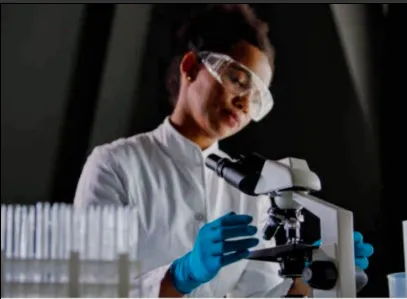
Payroll without pipettes: Why you cannot build a first-world economy on 0.09% R&D – A nation cannot industrialise on borrowed brains.
Read Section 3 of the 2027 Budget Statement and the ambition leaps off the page. Government promises a “New Economy” built on critical-minerals refining, biomanufacturing, nuclear baseload power, and a National Artificial Intelligence Centre. It vows to ban exports of raw bauxite, manganese, cocoa, and small-scale gold between 2028 and 2030.
Every patriot wants that future. We are tired of exporting raw red dirt and importing finished steel. Yet a forensic audit of the 2027 Budget’s actual expenditure appendices exposes a fatal gap between the speech and the spreadsheet. You cannot decree value addition from a podium while starving the laboratories that make value addition possible.
Start with a simple search of the 315-page budget document. Nowhere in the fiscal tables is there a dedicated line item for the Ghana National Research Fund (created under Act 1056 to move our research funding toward the African Union’s 1 per cent of GDP benchmark).
Even the acronym “R&D” does not appear in the budget’s official list of abbreviations. Let us do the arithmetic. Ghana’s nominal Gross Domestic Product is projected to reach GH¢1,806.06 billion in 2027.
If we honoured the African Union’s minimum target of investing 1.0 per cent of GDP in Research and Development, Ghana would commit GH¢18.06 billion to scientific and industrial discovery next year.
Turn to Appendix 4A. The entire Ministry of Environment, Science and Technology (MEST) receives a gross allocation of GH¢2.44 billion across all sources. Even that figure is a mirage. Tucked inside MEST’s capital budget is a GH¢685 million foreign loan for the Keta Sea Defence coastal engineering project.
Strip out those sea-defence boulders, and the entire core envelope for environment, science, and research drops to GH¢1.75 billion. That is 0.097 percent of GDP, less than one-tenth of the African Union benchmark.
Worse still, look at the four-year trajectory in Appendices 4A through 4D. As our economy grows toward 2030, core science and environment spending shrinks as a share of national output every single year: falling from 0.097 per cent of GDP in 2027 to 0.083 per cent in 2028, 0.077 per cent in 2029, and 0.073 per cent by 2030. We are marching forward in our speeches and walking backwards in our spreadsheets.
Follow the domestic tax cedi inside the Ministry of Environment, Science and Technology, and the picture grows starker. In 2027, central government provides MEST with GH¢642.11 million from direct domestic revenue (GoG).
– GH¢554.28 million (86.3 per cent) goes strictly to Compensation of Employees—paying monthly salaries.
2. GH¢27.82 million (4.3 per cent) goes to Goods and Services—the money that actually keeps laboratories open, buys chemical reagents, and funds field trials.
3. GH¢60.00 million (9.3 per cent) goes to Capital Expenditure (CAPEX)—buying scientific instruments and upgrading facilities.
Now open the hood on that GH¢60 million domestic capital budget. Exactly GH¢50 million of it goes to a single project: the Foundry and Machine Tooling Centre. Another GH¢10 million goes to the Electron Beam Irradiation Facility under Goods and Services.
What is left for the rest of Ghana’s entire public scientific establishment?
Across all 13 research institutes of the Council for Scientific and Industrial Research (CSIR), the Ghana Atomic Energy Commission (GAEC), the Nuclear Power Institute, the Ghana Space Science and Technology Institute, and Ministry headquarters combined, the Treasury allocates just GH¢10.00 million in domestic capital expenditure and GH¢16.57 million in Goods and Services for the whole of 2027.
Ten million cedis—roughly US$620,000—is what a single mid-sized metallurgical lab spends on one electron microscope. Here, it is rationed across thirteen national research institutes and an atomic energy commission for twelve months.
By 2029, total domestic CAPEX for MEST is programmed to collapse from GH¢60 million down to GH¢16.34 million. Take out the Foundry Centre, and the rest of our science ministry is left with GH¢2.72 million in capital tools.
Meanwhile, GoG salary payments at MEST climb to GH¢799.78 million by 2030.
We hire brilliant Ghanaian PhDs, put them on the public payroll, lock them inside dark laboratories without pipettes or reagents, and then ask why Ghana imports toothpicks and transformer oil.
Defenders of the budget will point to Appendix 7 and argue that MEST is projected to retain GH¢964.79 million in Internally Generated Funds (IGF) in 2027.
Check who collects that money. A massive 88.1 per cent (GH¢850.30 million) belongs to a single regulatory body: the Environmental Protection Authority (EPA), collected from environmental permits and levies. And as Appendix 8B shows, the EPA spends GH¢725.23 million of that retained cash on its own staff compensation (GH¢354.02 million) and administrative goods and services (GH¢371.21 million).
What about our actual scientists? All 13 CSIR institutes combined are projected to generate just GH¢63.92 million in 2027. The Nuclear Power Institute is projected to generate GH¢10,000 for the entire year—barely GH¢833 a month.
Because the state refuses to fund their benches, our premier crop, soil, food, industrial, and building research scientists are reduced to hawking bottled water, soil tests, and oil-palm seedlings to keep their lights on.
Look at Paragraph 1270 of the Budget, which proudly reports that CSIR developed “six Innovative Food Technologies, including Vegetable Seasoning Cubes, Drum-Dried Tiger Nut Pudding and Mango Seed Bread” in 2026.
No disrespect to mango seed bread or tiger nut pudding.Our scientists are doing heroic work with empty pockets. Yet you do not refine lithium, smelt manganese, or produce vaccine biologics on a tiger-nut budget.
Sixty Times More for Stadia Than for Core Labs
Budgets are moral documents. They tell you what a republic truly values when the microphones are switched off.
In Paragraph 1575 and Appendix 4A, the 2027 Budget allocates GH¢600 million in domestic GoG capital expenditure to begin constructing ten new regional sports stadia.
Ten new sports stadia (2027 GoG CAPEX): GH¢600 million.
All MEST domestic CAPEX (including the Foundry): GH¢60 million.
All CSIR (13 institutes), GAEC & MEST Hqtrs domestic CAPEX outside the Foundry: GH¢10 million.
We are spending ten times more tax capital on sports stadia in 2027 than on the entire Ministry of Environment, Science and Technology—and sixty times more than on the core capital equipment of all our national research institutes combined.
Even the headlines in Section 3—US300 million for a National AI Centre, US200 million to train 2,000 nuclear scientists, and US$1 billion for pharmaceutical biomanufacturing—are parked inside a generic GH¢30 billion multi-sectoral lump sum rather than anchored in our statutory research institutions.
Three Fixes for Parliament’s Science and Finance Committees
If Ghana wants true economic sovereignty, Parliament must rewire these priorities before passing the 2027 Appropriation Bill:
Operationalise and Capitalise the Ghana National Research Fund (Act 1056): Carve out at least GH¢1.5 billion (just 5 per cent of the GH¢30 billion New Economy envelope in Appendix 3C) to seed the National Research Fund in 2027, tied strictly to applied industrial patents in mineral processing, renewable energy hardware, seed breeding, and biomanufacturing.
Flip the Lab-to-Payroll Ratio at CSIR and GAEC: Ring-fence at least GH¢250 million in domestic GoG capital expenditure and reagents for CSIR’s 13 institutes and GAEC so our scientists spend their days solving industrial bottlenecks for Ghanaian factories rather than chasing petty consultancy fees to buy test tubes.
Link the EPA’s GH¢850 Million IGF Windfall to Green R&D: Direct that at least 15 per cent of the Environmental Protection Authority’s GH¢850.30 million in retained environmental permit fees be transferred annually to CSIR and university laboratories developing local clean-tech, waste-to-energy, and climate-resilient crop solutions.
Nations do not become great by cheering from the stands of ten new stadia while their laboratories gather dust. True independence is forged at the lab bench. If we want a first-world industrial economy somewhere in 2030s, we must stop funding payrolls without pipettes and start backing Ghanaian brains.