


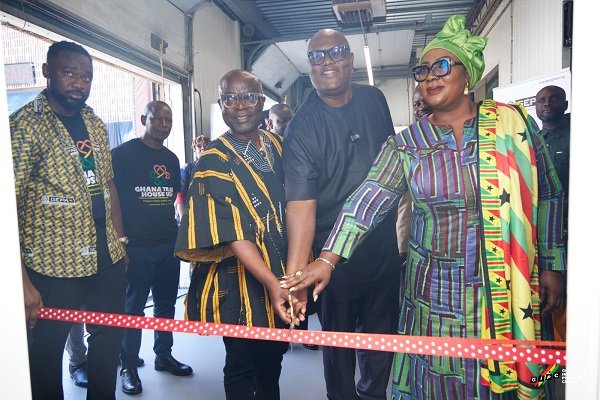
Ghana has embarked on a strategic trade expansion initiative, officially opening its first dedicated Ghana Trade House in Philadelphia to accelerate its export ambitions to the United States. The move, spearheaded by the Ghana Export Promotion Authority (GEPA), marks a pivotal step in the country’s broader strategy to increase non-traditional exports to the US from $405.6 million in 2025 to $1 billion by the end of 2026.
A Strategic Expansion of Ghana’s Global Trade Presence
The Philadelphia Trade House joins a growing network of Ghana’s overseas commercial hubs, following the establishment of similar facilities in London (March 2026) and Kenya (2023). These centres are designed to enhance Ghana’s commercial visibility, support local exporters, and provide structured pathways for market entry, investment promotion, and business partnerships.
Inaugurated during the Invest Ghana Business Forum and Exhibition in the US, the Philadelphia Trade House was launched with the collaboration of GEPA, the Ghana Investment Promotion Centre (GIPC), the Ghana Free Zones Authority (GFZA), and the Ghana Export-Import (EXIM) Bank. Positioned as a one-stop commercial hub, the facility aims to serve as a critical bridge for Ghanaian businesses seeking to penetrate or expand within the American market.
Comprehensive Services to Drive Export Growth
The Trade House will offer a range of tailored services, including:
– Market intelligence and trade advisory – Providing exporters with real-time data on US market trends, regulatory requirements, and consumer preferences.
– Export matchmaking – Facilitating direct connections between Ghanaian producers and US buyers, reducing barriers to entry.
– Product showcasing and trade exhibitions – Offering platforms for Ghanaian businesses to display their goods at key US trade events.
– Investment support in priority sectors – Focusing on high-growth industries such as agro-processing, manufacturing, renewable energy, and digital services.
– Regulatory guidance under AGOA – Assisting exporters in navigating the African Growth and Opportunity Act (AGOA), which provides duty-free access for eligible African goods to the US market.
– Financing solutions through the Ghana EXIM Bank – Providing export credit guarantees, trade finance, and risk mitigation services to support business expansion.
Beyond trade facilitation, the Trade House is expected to strengthen economic diplomacy by engaging the Ghanaian diaspora in the US, fostering bilateral relations, and promoting Ghana as a preferred investment destination.
Record Trade Growth Fuels Ambitious Export Targets
Trade between Ghana and the US has been rapidly expanding, with total bilateral goods trade reaching an estimated $2.5 billion in 2025, according to the US Trade Representative (USTR) and US Census Bureau.
Key trade figures highlight strong momentum:
– US exports to Ghana surged by 32.6%, reaching $1.3 billion.
– Ghana’s exports to the US totaled $1.2 billion, reflecting a 96% year-on-year increase in March 2026 alone.
– March 2026 exports included $52.8 million in cocoa beans and $40.9 million in cocoa paste, reinforcing Ghana’s dominance in global cocoa markets.
– The country remains the world’s leading exporter of yams, with the US as its largest importer.
While Ghana is a global leader in traditional exports like cocoa and gold, the new Trade House is positioned to accelerate the growth of non-traditional exports, including processed foods, textiles, pharmaceuticals, and technology-driven products.
Recent Trade Missions Yield Significant Results
The establishment of the Philadelphia Trade House follows a series of high-impact trade promotion missions led by GEPA in 2026:
– Fruit Logistica (Berlin, February 2026) – A delegation of Ghanaian horticultural producers secured purchase orders exceeding $350 million.
– Macfrut (Italy, 2026) – Generated additional orders worth over $150 million.
– Salon International de l’Alimentation (SIAL, Canada, 2026) – Resulted in $100 million+ in new business deals.
These successes underscore Ghana’s growing reputation as a reliable supplier of high-quality agricultural and processed goods, reinforcing the need for permanent trade infrastructure in key markets like the US.
Leadership Commends Strategic Initiative
At the inauguration, Francis Kojo Kwarteng Arthur, CEO of GEPA, described the Philadelphia Trade House as “both symbolic and strategic” in Ghana’s global trade strategy.
“Today, we formally establish our flagship Export Trade House here in Philadelphia. As Ghana remains one of Africa’s most compelling destinations for business and investment, we are committed to making global market entry as seamless as possible for our exporters.”
Arthur emphasized that the initiative builds on Ghana’s recent trade successes, including the $600 million+ in orders secured through targeted international missions.
Simon Madjie, CEO of the Ghana Investment Promotion Centre (GIPC), echoed the sentiment, calling the Trade House a “strategic national asset” that will strengthen Ghana’s global footprint and attract foreign direct investment (FDI).
“When investors witness the quality of Ghanaian goods, understand the depth of our local enterprises, and identify partnership opportunities, they transition from curiosity to commitment. GIPC will continue collaborating with GEPA, government agencies, the private sector, and diaspora networks to convert trade visibility into tangible investment outcomes.”
Dr. Mary Awusi, CEO of the Ghana Free Zones Authority (GFZA), highlighted the initiative’s alignment with export-led growth strategies, stating that it will boost investor confidence and expand Ghana’s participation in global value chains.
A Blueprint for Future Trade Expansion
The opening of the Philadelphia Trade House is part of Ghana’s long-term vision to diversify its export base, reduce reliance on traditional commodities, and position itself as a key player in global supply chains. With record trade growth and increasing US market access, the country is well-positioned to achieve its $1 billion export target by 2026—provided strategic trade infrastructure and support mechanisms remain robust.
As Ghana continues to leverage its diaspora networks, AGOA benefits, and emerging industries, the Philadelphia Trade House serves as a critical catalyst in its journey toward sustained economic growth and trade diversification.