


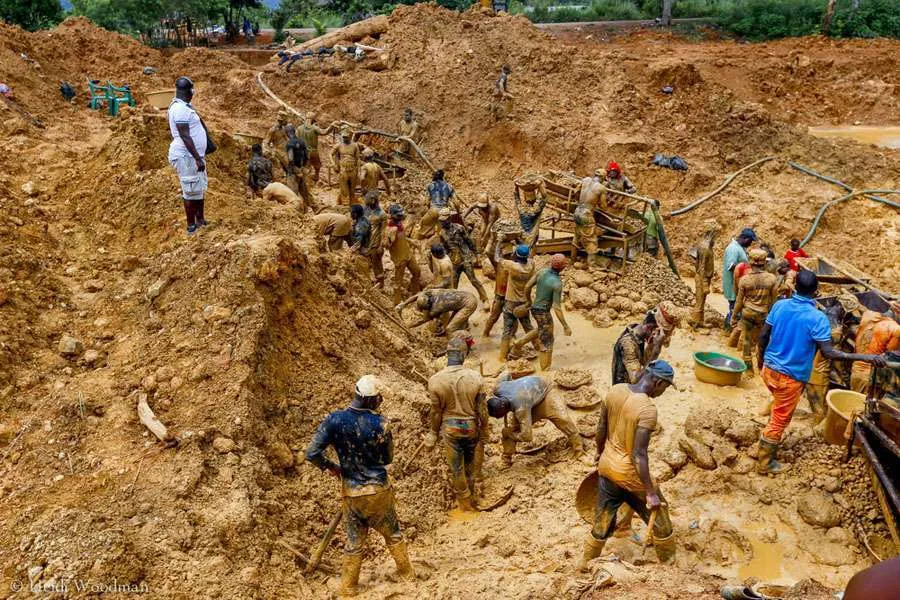
Galamsey threatens oil palm industry in Central Region – TOPP – Illegal small-scale mining, popularly known as galamsey, in the Twifo Atti Morkwa District of the Central Region is undermining the operations of Twifo Oil Palm Plantation (TOPP) Limited, the company has warned.
Managing Director of TOPP, Mr Daniel Kwodwo Nyame, said galamsey activities were depriving the company of trained labour and polluting natural water sources essential to its operations.
He explained that despite significant investments in training workers in harvesting, pruning, equipment maintenance and other technical operations, many had abandoned the plantations for galamsey because of the higher incomes associated with the illicit activity.
As a result, TOPP is currently achieving only about 50 per cent of its targeted 80 per cent harvesting capacity, a situation he said was affecting production and the long-term sustainability of the business.
Mr Nyame made the remarks when the leadership of the Oil Palm Development Association of Ghana (OPDAG), led by its President, Mr Paul Amaning, undertook a working tour of selected oil palm processing sites in the Central Region.
The delegation visited TOPP and Sasah Abban Enterprise, an artisanal oil palm processing facility at Twifo Praso.
Mr Nyame said TOPP employed about 500 permanent workers, while its seasonal workforce could increase to about 2,000, making it the largest agro-processing employer in the Central Region.
He said the company currently operated 8,000 hectares of oil palm plantations and a 30-tonne processing mill, with plans to expand the mill’s capacity to 45 tonnes and double its plantation area to 16,000 hectares.
He also expressed concern about the pollution of the Pra River by galamsey operators, saying the company previously relied on the river as an alternative water source during the dry season.
“But today, you cannot use it because it is heavily polluted. Even the small one that we are drawing currently from at the beginning of the year, there is a challenge where some people tried to prevent us. Fortunately, the DCE and the security team helped us to clear them,” he said.
He called for sustained and stringent measures to tackle illegal mining, warning that its impact on water resources and the availability of labour posed a serious threat to the industry.
Mr Nyame also identified the smuggling of palm oil into the country as a major challenge for local producers, saying it was undermining their competitiveness and affecting their ability to offer farmers fair prices.
He said local producers were struggling to sell their products to refineries because of the influx of cheaper smuggled oils, forcing them to offer significant discounts to attract buyers.
According to him, most products originated in Asia and entered the country through unapproved routes in the Volta, Northern, and Western regions.
“So, these foreign countries can land the cost almost 20 per cent less than the cost of what our off-takers are paying for it, and that gives them a head start,” he noted.
Mr Nyame said the effects of the practice extended beyond palm oil producers to local soap manufacturers, many of whom depended heavily on palm oil and its by-products.
He said the influx of smuggled oil and related products was making it increasingly difficult for local manufacturers to compete with cheaper imported brands.
He added that the practice had persisted for nearly four years despite several engagements with the government.
Although the Tree Crops Development Authority (TCDA) had intervened, he called for stronger enforcement and sustained government action to address the problem.
“Fortunately, TCDA has been intervening and so far, so good, but for a long-term solution, we would have to continue to engage the government to find a solution to this rampant smuggling that is bedevilling the industry,” he emphasised.
For his part, Mr Amaning expressed concern about the growing incidence of smuggling and urged the government to regulate the volume of imported vegetable oils to create a larger market for local producers and processors.
He described the uncontrolled importation of vegetable oils as a regulatory failure and called for a traceability and revenue assurance system under which every litre of imported oil would be coded.
He said the system would enable authorities to establish the origin and volume of imported products while improving the monitoring and regulation of imports.
On the government’s proposed US$500 million fund for the oil palm industry, Mr Amaning appealed for the resources to be channelled towards improving processing facilities, expanding plantations, training personnel and strengthening regulatory enforcement across the value chain.
He also called for the modernisation of small- and medium-scale processing mills through grants and concessionary loans to improve efficiency and productivity.
Mr Amaning further urged the government to support the establishment of 100,000 hectares of oil palm plantations nationwide to increase domestic production and reduce Ghana’s dependence on imported palm oil.
He said one hectare of oil palm plantation could produce about three tonnes of crude palm oil, meaning 100,000 hectares could generate an estimated 300,000 tonnes annually and position Ghana to achieve self-sufficiency in palm oil production.