


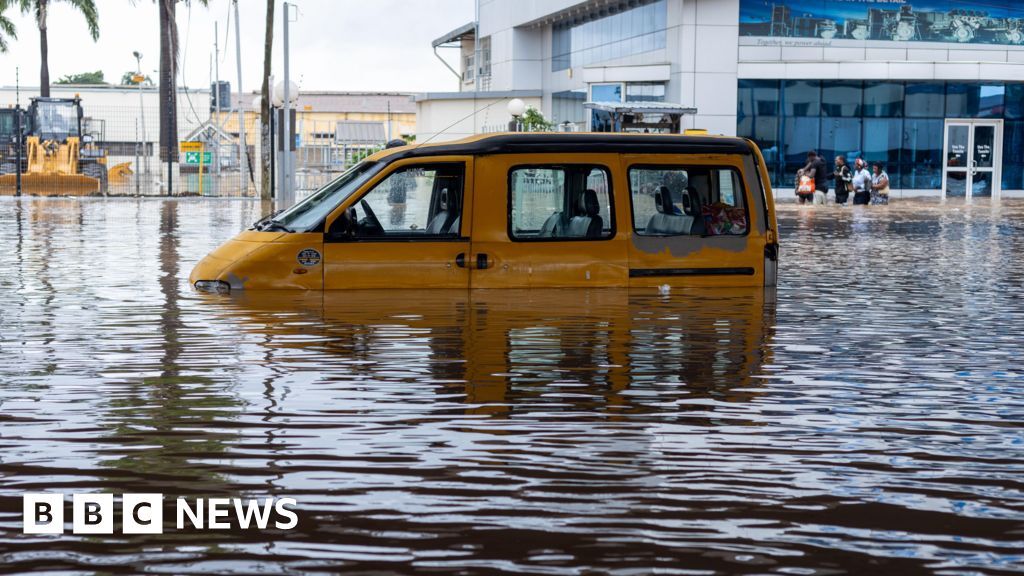
Ghana’s bustling capital, Accra, has been plunged into chaos following catastrophic flooding triggered by torrential rains over the weekend, leaving at least 13 people dead and hundreds displaced. The Ghana National Fire Service (GNFS) confirmed the grim toll, warning that the death count could rise as rescue operations continue. Meanwhile, low-lying neighborhoods remain submerged, with vehicles, homes, and infrastructure destroyed under rising waters.
A Crisis of Unprecedented Scale
The 2024 downpours—described as among the heaviest in recent years—have drowned Accra’s drainage system, exposing the city’s vulnerabilities. Preliminary data from the Ghana Meteorological Agency (GMA) indicates that over 140mm of rain fell in a single day, more than double the 56mm recorded in the same period last year. Experts have linked the extreme weather to climate change, while officials warn that more rain is expected as a major storm system approaches from the east.
President Nana Akufo-Addo’s office issued a urgent public advisory, cautioning residents to stay indoors if safe, avoid flooded roads entirely, and immediately relocate to higher ground if homes are inundated. The emergency hotline (112) has been activated for distress calls, but trapped residents report hours of struggle against rising waters.
“I’ve mopped my room more than eight times—it’s still flooded. I can’t even step outside because the streets are underwater too.” — Patience Naa Adjeley Adjei, a schoolteacher whose home was submerged.
Another resident, Philip Mensah, shared on social media that his 1970s vinyl record collection—a lifetime of memories—was destroyed by floodwaters.
Government and Emergency Response in Full Swing
A multi-agency rescue operation has been deployed across the city, involving:
– Ghana National Fire Service (GNFS) – Over 470 people rescued so far.
– Police and military – Conducting search-and-rescue missions and roadblocks to prevent further casualties.
– National Disaster Management Organisation (NADMO) – Coordinating evacuation efforts and distributing relief supplies.
– Interior Ministry – Monitoring law and order, ensuring property protection, and preventing looting amid the chaos.
Despite these efforts, a major fire broke out at a rubber factory in the city, adding to the multi-faceted crisis. Power supply has been temporarily cut in flood-hit areas by GRIDCo and ECG due to damaged substations, leaving thousands in the dark.
Structural Failures and Long-Term Risks
Experts and officials have pointed to systemic issues exacerbating the flooding:
- Poor Drainage Infrastructure – Clogged gutters, illegal constructions on waterways, and unplanned urban expansion have compromised Accra’s ability to manage heavy rainfall.
- Climate Change Impact – The increased frequency of extreme weather events suggests that Accra’s growth outpaced infrastructure development, leaving communities vulnerable to recurring disasters.
- Historical Precedent – In 2015, similar floods led to a deadly fuel station explosion, killing 150 people. This year’s crisis has reignited fears of a repeat disaster.
President Akufo-Addo, after an aerial survey of the damage, ordered the immediate demolition of illegal structures blocking drainage channels. “The irresponsible actions of a few endanger entire communities,” he stated, emphasizing the need for strict enforcement of urban planning laws.
Climate Experts Warn of Worsening Trends
Ewurabena Yanyi-Akofur, Director of WaterAid Ghana, urged immediate action to prevent future catastrophes. “What we see in Accra is not an isolated event but a pattern—intensified by climate change and unchecked urbanization,” she said. “Stronger planning, early warning systems, and community preparedness are critical to saving lives.”
The GMA has reiterated its warnings, advising residents to:
– Avoid sheltering under trees (risk of lightning strikes).
– Stay away from downed power lines (electrocution hazard).
– Never walk or drive through floodwaters (hidden currents can be deadly).
Accra’s Vulnerabilities Under the Microscope
With a population exceeding 4 million, Accra is Africa’s fastest-growing capital, but its rapid expansion has outpaced essential services. Informal settlements, inadequate waste management, and weak governance have amplified the flood’s devastation.
Residents like Adjeley Adjei and Mensah are not alone—entire neighborhoods remain cut off from basic services, with food, clean water, and medical aid in short supply. The long-term recovery will require coordinated efforts from government, NGOs, and international partners.

Rescue teams navigate flooded streets in Accra as emergency operations continue.

A submerged vehicle in a low-lying neighborhood, highlighting the severity of the flooding.

Trapped residents wade through floodwaters, with authorities urging immediate evacuation.

Downed power lines and damaged infrastructure in a flood-hit Accra suburb.

President Nana Akufo-Addo inspects flood damage during an aerial survey, vowing action against illegal constructions.

Residents mopping flooded homes as relief efforts continue in the aftermath of the disaster.