


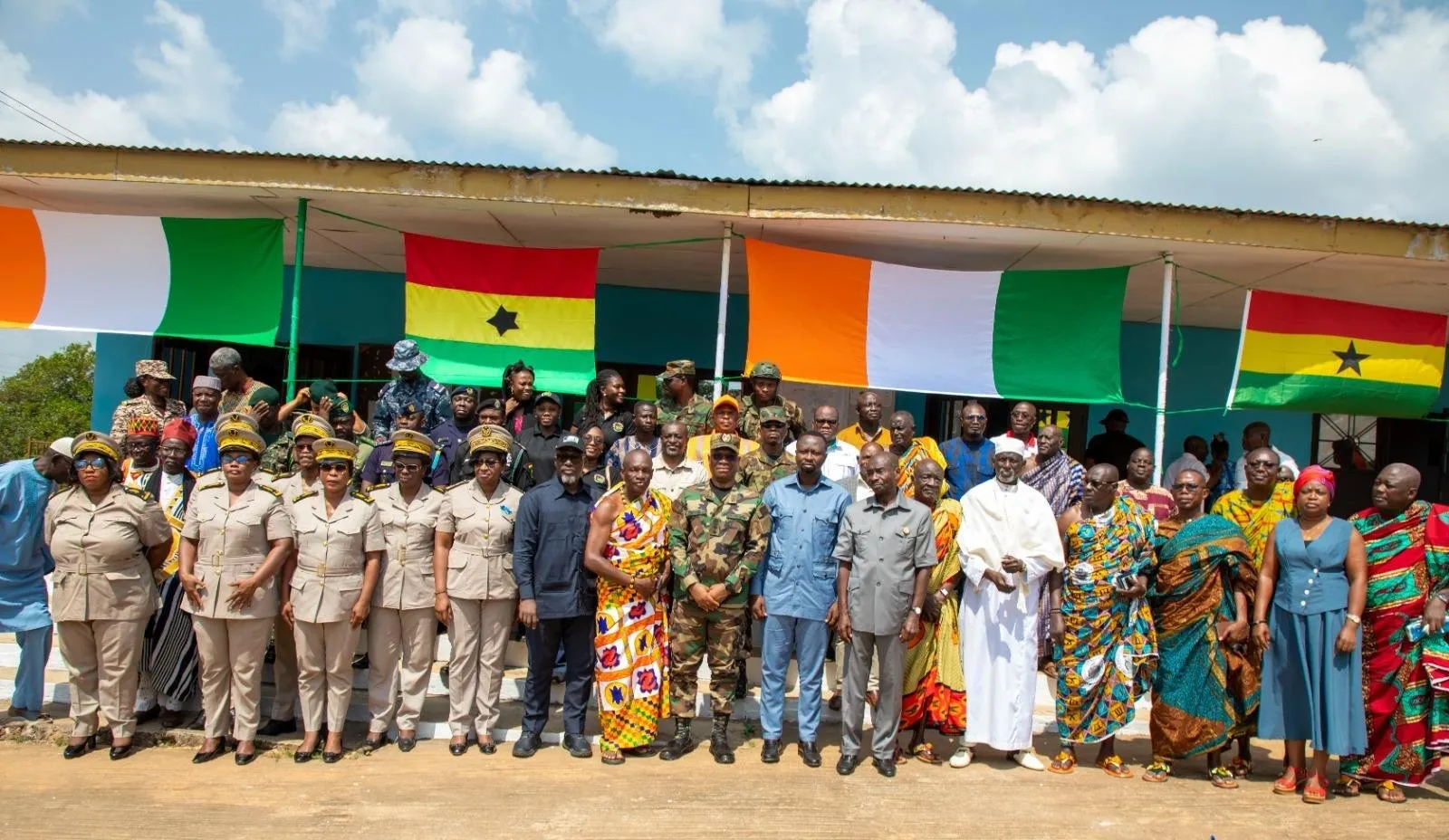
Ghana and Cote D’Ivoire launch Phase 2 of Joint International Land Boundary reaffirmation exercise – Ghana and Côte d’Ivoire have jointly launched the second Phase of the joint land boundary reaffirmation exercise at Niable, in Cote d’Ivoire.
The event which took place at Niable, the cross-border community of Sefwi Oseikojokrom of the Bia West District of the Western North Region, marked another significant milestone in efforts by the two neighbouring countries to strengthen boundary management and promote peaceful coexistence between cross-border communities.
The Phase Two of the Joint Ghana-Côte d’Ivoire Land Boundary Reaffirmation Exercise is expected to cover a total distance of 392km of the common land boundary, starting from the Aowin Municipality of the Western North Region to the Banda District of the Bono Region.
A total of 57 new International Boundary Pillars is expected to be constructed along the targeted distance, with the pillar construction suprervised by Cote d’Ivoire.
Speaking at the ceremony at Niable, the Commissioner General of the Ghana Boundary Commission (GhBC), Major General Anthony Ntem noted that the joint reaffirmation exercise aims to determine territorial limits of each country, which is vital for development planning.
He added that clearly defined boundaries are essential to strengthening border security and deepening the longstanding relations between Ghana and Côte d’Ivoire, noting that the exercise will prevent boundary related misunderstanding and disputes.
The reaffirmation exercise is, “Intended to clearly identify the territorial limits of Ghana and Côte d’Ivoire.
These limits will enable our respective Central Governments plan development and provide essential services within their territories.
The Pillars will also clarify territorial jurisdiction and help prevent boundary-related misunderstandings and disputes,” Major General Ntem clarified.
The Commissioner General of GhBC further called on the border residents to cooperate fully with the joint Technical Team, assuring them that the exercise will not disrupt their legitimate cross-border movements and livelihoods or impede development activities.
“I wish to reassure our communities that the reaffirmation exercise will not prevent legitimate cross-border movement or disrupt your livelihoods. Such movements should comply with applicable national laws, immigration requirements and agreed cross-border arrangements,” the Commissioner General added.
He entreated the border residents to provide the necessary support to ensure the successful implementation of the exercise and encouraged community members to remain vigilant and report suspicious activities along the boundary to the appropriate authorities to help safeguard peace and security.
For his part, the Executive Secretary of the National Boundary Commission of Côte d’Ivoire, Dr Diakalidia Konate noted that boundary disputes are the major sources of conflicts in Africa, reiterating the importance of the reaffirmation exercise.
He stressed that the reaffirmation exercise aims to make the International Boundary Line more visible to avoid any dispute, and cautioned the communities against misinformation and disinformation on the joint activities that may circulate online.
Dr Konate encouraged the members of the Joint Land Boundary Technical and Sub-Technical Committees to work tireless to ensure the success of the exercise and entreated the traditional authorities and the border residents to also assist and ensure peace prevailed in the course of the exercise.
Other speakers at the event included the representative of the Governor of Battie in Cote d’Ivoire, the Mayor of Niable, the District Chief Executive for the Bia West District, and members of the Joint Ghana-Côted’Ivoire Technical Team.
The second phase of the joint land boundary reaffirmation exercise underscores the continued commitment of Ghana and Côte d’Ivoire to strengthening bilateral relations, preventing boundary-related conflicts and promoting lasting peace, security and socio-economic development in communities along their common border.
The Phase Two exercise is expected to be completed by June 2026, with field technical works which commenced on Monday 15 November 2026 set to be completed before the end of the year.
The Pillar construction stage of the exercise will commence soon after, and the construction will be supervised by Côte d’Ivoire.