


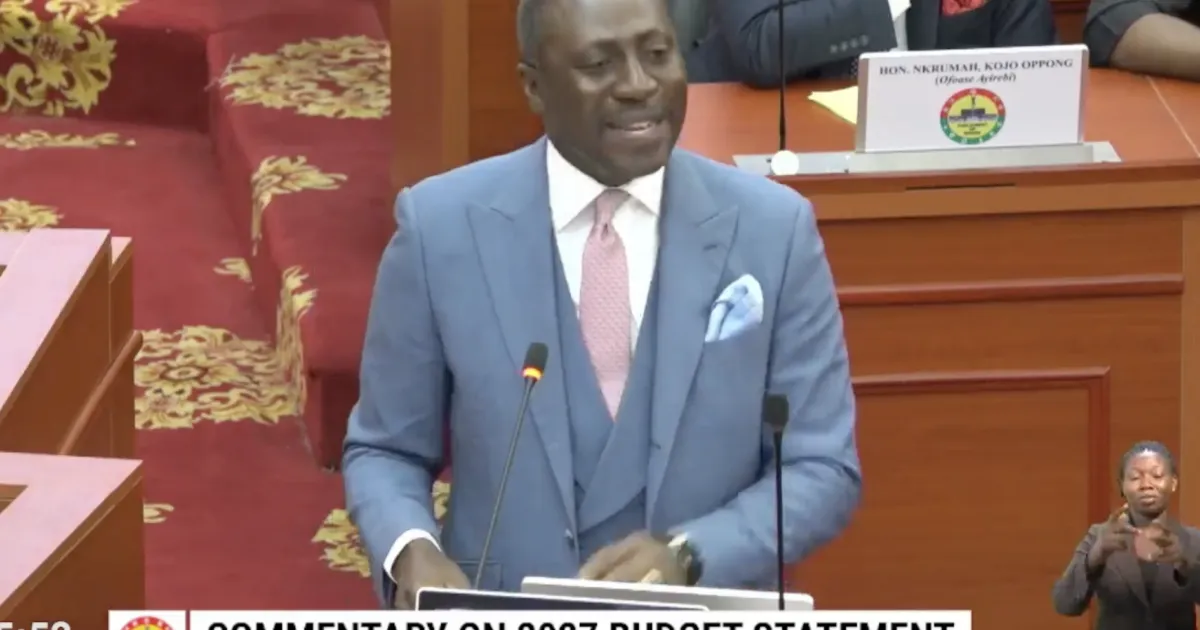
‘What has changed in the pockets of Ghanaians?’ – Afenyo-Markin challenges government – Minority Leader Alexander Afenyo-Markin has questioned the impact of the government’s reported economic gains on ordinary Ghanaians, arguing that official statistics do not reflect the financial realities facing households and businesses.
He described what he called a divide between the “paper economy” presented by the government and the “pocket economy” experienced by citizens.
Contributing to the closing debate on the 2027 Budget Statement in Parliament on Thursday, November 26, 2026, Afenyo-Markin said the two economies were increasingly disconnected.
“One lives in speeches as presented by the Finance Minister, social media posts as advanced by the government communications minister, lovely presentations and settings for only NDC government functionaries and party communicators belong to this first arm of the economy. Then the real one lives in the kitchen, the classroom, the market, and the struggling entrepreneurs and the people of Ghana,” he stated.
Afenyo-Markin argued that improvements in economic indicators would have little meaning to citizens if they did not translate into lower living costs and better financial conditions.
“The market woman cannot eat paper. The student cannot pay school fees with a government statement. The parent counting coins at the end of the month cannot feed a child with a number,” he said.
He questioned whether the reported decline in prices and improvements in economic indicators were making a meaningful difference to households and small businesses.
“So I ask again, what has changed in the pocket of Ghanaians? If prices come down on paper, but not at the market, who has been helped? If the numbers go up but the small business owner is still closing a shop, who has been saved?” he added.
The government has highlighted improvements in key macroeconomic indicators, including declining inflation and relative stability in the exchange rate, as evidence of progress in its economic management.
The Minority, however, has repeatedly argued that these gains are not translating into sufficient relief for ordinary Ghanaians, particularly households and small businesses facing high living costs.
The debate on the 2027 Budget is expected to conclude with a vote in Parliament.